Kinetic Silk | By ArtLoft Editorial |
What Is Air-Responsive Art?
A clear guide to art that lets ambient air become part of the visual experience.
Air-responsive art in one sentence
Air-responsive art uses the movement already present in an environment as part of how the work is seen. A current may turn a balanced element, lift a suspended form or shift a lightweight textile surface. The work does not need to perform continuously. It may remain nearly still for long periods, then register a passing person, an opening door or a subtle change in the room.
The phrase describes a relationship among material, installation and air. It does not describe a single style, medium or historical movement. A delicate textile, a mobile and a suspended sculptural element can all respond to air while looking and behaving very differently. The useful question is not whether they share one appearance. It is whether air is an intended part of the encounter rather than an accidental disturbance.
How it relates to kinetic art
Kinetic art is the wider field. The Museum of Modern Art notes that kinetic works may use motors or may be structured to respond to natural air currents. Air-responsive art sits inside that larger history, but the narrower term helps a viewer understand the source of movement before making assumptions about power, programming or machinery.
That distinction matters in a room. A motorized sculpture may repeat a designed sequence with a defined speed and operating period. An air-responsive work behaves according to material sensitivity and changing conditions. Its movement may be irregular, slight and impossible to repeat on command. The absence of a programmed cycle is not a missing feature. In many works it is part of the artistic decision.
Air does not have to mean spectacle
Online videos often reward constant, visible motion. An artwork in a home, gallery or private room has a longer life than a short demonstration. It must still hold attention when the air is quiet. The most convincing air-responsive work therefore has a meaningful resting state. Its composition, material, color and relation to the wall should remain deliberate even when nothing appears to move.
Movement can then become a second reading. A fold changes. A reflection shifts. A balanced element turns and settles. These modest events can sharpen attention because they are not scheduled. The viewer notices the room and the work at the same time. This is a different pleasure from watching a device complete a mechanical routine.
Material determines the response
Air does not act on every object in the same way. Weight, stiffness, surface area, balance, suspension, tension and distance from the wall all matter. A rigid metal element may require a different current from a light textile surface. A silk square may register a small environmental change that a heavier woven object would ignore. Neither response is automatically better. Each belongs to a different material and installation logic.
This is why category language should never replace the object record. A collector should still know the exact medium, dimensions, support, hardware, installation method and care requirements. If the work includes several components, the record should explain what moves, what remains fixed and which relationships are essential to the artist's intended configuration.
The room becomes part of the work's behavior
An air-responsive artwork cannot be evaluated only as an isolated object. Doors, windows, supply vents, return vents, fans, curtains, circulation and ceiling height can change what reaches the work. The same piece may be almost still on one wall and unsettled on another. A dramatic demonstration in strong airflow does not prove that the same location is appropriate for long-term display.
Before installation, observe the proposed wall at several times. Note which mechanical systems are operating, how people move nearby and whether doors create sudden pressure changes. The aim is not to chase maximum motion. It is to find a position where the work can register ordinary life without repeated contact, forced movement or a care condition the object was not designed to tolerate.
Light can make small motion visible
Air produces physical movement, while light affects how that movement is perceived. A slight change in angle can alter reflection, shadow, color depth and the visibility of a fold. This can make a modest material response feel visually significant. It also means a single front-facing photograph may not describe the work adequately.
Light remains a care question as well as a visual one. Textile guidance from conservation institutions emphasizes the cumulative effects of exposure and the need to consider the environment around an object. A responsive textile should not be placed in direct sun simply to make it look more animated. The placement decision must balance the intended experience with material-specific care.
Air-responsive textile art
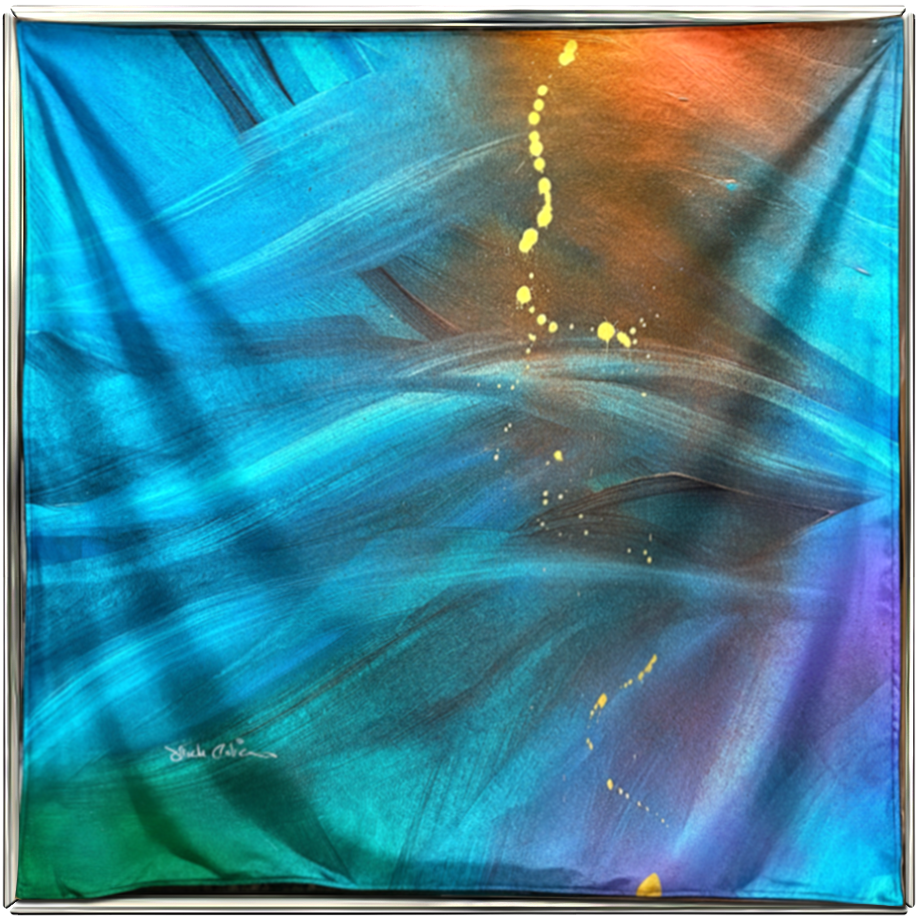
Air-responsive textile art uses a flexible textile surface so ambient air and changing light become part of the viewing experience. The image may remain authored and stable while the surface carrying it shifts. This makes the textile more than a passive support. Drape, reflection, edge behavior and temporary folds enter the composition without replacing the artwork printed, woven, dyed or otherwise formed on the material.
The category includes several possible approaches. A textile may hang freely, be suspended, be held at selected points or be presented within a system designed to establish a particular relationship with the wall. Those approaches create different condition, access and maintenance questions. The phrase air-responsive does not promise that every method is reversible, appropriate for wear or suitable for a valuable scarf.
Where Kinetic Silk Art fits
Kinetic Silk Art is ArtLoft's term for the complete experience created when an ArtSoie silk edition is displayed in Veatro. ArtSoie supplies the authored silk artwork. Veatro supplies the stainless-steel display and release system. The visible movement comes from the response of silk to ambient air and changing light, without a motor or electronic animation.
This makes Kinetic Silk one expression of air-responsive textile art, not a replacement name for the entire field. Keeping the terms separate is important. The broader category helps a reader understand the behavior. The ArtLoft name identifies a specific relationship among ArtSoie, Veatro, edition records and the collector experience.
What to ask before collecting
Ask first what initiates movement and whether that source is part of the work. Then ask what the artwork looks like at rest, what clearance it needs, how the environment was assessed and what maintenance belongs to the object. For textiles, request material, light, handling, storage and condition guidance. For moving hardware, ask what should be inspected and who is qualified to service it.
A useful demonstration should show ordinary conditions, not only the most dramatic response available. It should identify whether doors, fans, vents or windows were operating. It should also show the work at rest. This gives the collector a fairer basis for judging whether movement deepens the artwork or merely makes a persuasive clip.
A category built on attention
Air-responsive art is compelling because it makes an invisible condition visible. It can reveal a room as active, even when that activity is quiet. The best examples do not need movement to rescue a weak object. They use movement to extend an already convincing relationship among image, material, balance and space.
For ArtLoft, that is the strategic bridge. A reader can begin with a real question about art that moves with air, understand the wider kinetic and textile context, and then discover Kinetic Silk as a specific collector experience. The category earns attention first. The product name follows only after the idea is clear.
Sources and editorial notes
ArtLoft Kinetic Silk product and movement records, reviewed July 2026
ArtLoft Public Claim Registry, reviewed July 2026
Museum of Modern Art: Kinetic art Open source
Canadian Conservation Institute: Textiles and the Environment Open source
Reviewed by ArtLoft Editorial. Materially updated 2026-07-13. Read the editorial policy.