Veatro | By Rissa Calica | 2026-05-01
Veatro: The Frame That Refuses Stillness
A study of stainless steel, quick release, and why the right frame can become part of the artwork's philosophy.
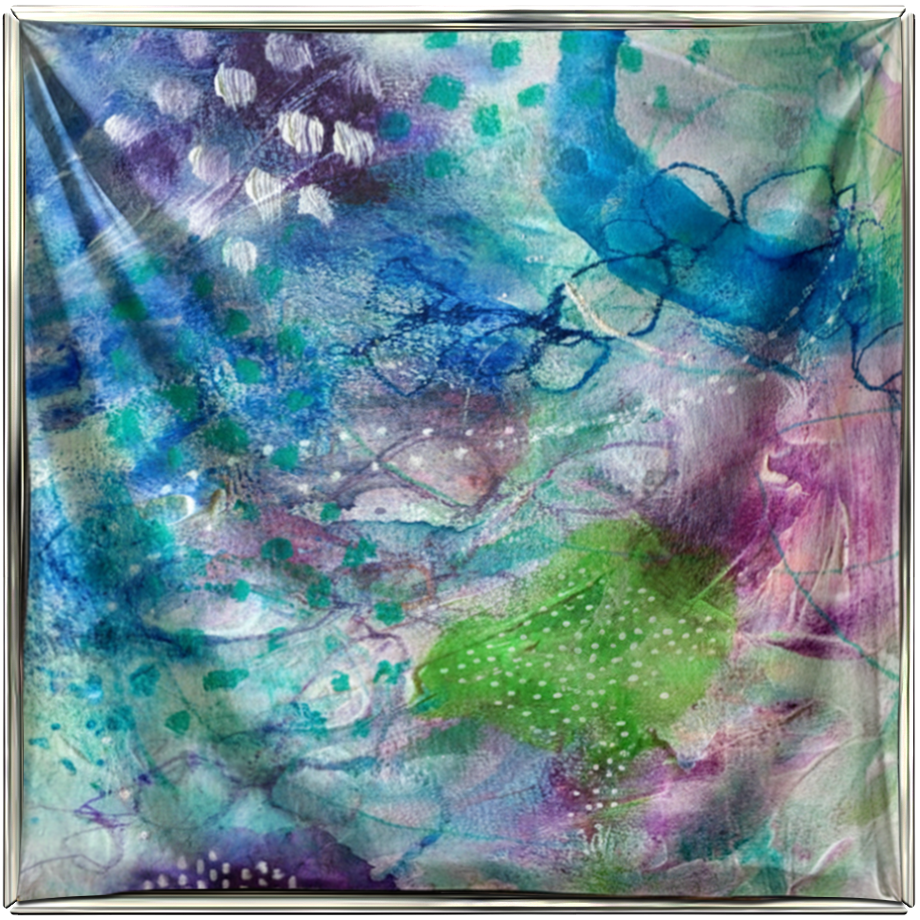
A frame usually knows its place. It finishes an edge, protects a surface, and establishes a respectful boundary between the artwork and the world. In the museum imagination, the frame is disciplined, quiet, almost invisible unless it is ornate enough to become historical. Veatro begins from a different question: what if the frame were not a border, but a behavior? What if the frame's purpose were not to freeze the artwork, but to hold it in the precise state where movement becomes visible?
That question matters because ArtSoie is silk. Silk does not want to be treated like paper pretending to be canvas. It has drape, lightness, tension, and response. A conventional frame can make silk look contained, but it can also flatten the very quality that makes silk worth choosing. Veatro accepts the material's nature. It is crafted in stainless steel, described by ArtLoft as patent pending, and made as a kinetic release system for silk art. Its intelligence lies in understanding that a good support does not dominate the supported thing. It gives the supported thing permission to become fully itself.
Engineering as Courtesy
The most elegant engineering often disappears into courtesy. A door that closes well, a chair that supports the body without announcement, a clasp that works every time, a frame that lets silk move: these are acts of respect. Veatro's stainless-steel structure brings a different kind of luxury to ArtSoie. It is not softness, sheen, or ornament. It is precision. It tells the collector that the silk is not being improvised into place. It is being held by a system designed for its specific life.
That specificity is important. The art market often treats display as an afterthought, something solved after the purchase. Veatro makes display part of the artwork's meaning. The frame becomes an answer to the question of how a silk collectible should inhabit a room. It should not sag into casualness. It should not be imprisoned behind glass. It should be given tension, air, and authority. It should be allowed to be both textile and artwork, and the frame should be intelligent enough not to force a false choice.
The Quick Release Philosophy
ArtLoft's language around Veatro includes one particularly striking idea: the silk can release when the collector is ready to leave. This is practical, but it is also philosophical. Most framed artworks imply permanence through immobility. They say, I belong here. Veatro says something more contemporary: I belong here, and I can move with you. In a world where serious collectors may live across cities, travel often, redesign spaces, or inhabit multiple identities, mobility is not a weakness. It is part of life.
The quick release does not make the work less precious. It makes care more agile. A collector can understand the silk as wall presence and personal object. An interior designer can imagine a room that changes with season, event, or mood. A scarf lover can see the artwork's second life without treating display as a storage solution. Veatro's release system quietly challenges the old idea that an artwork must be fixed to be serious.
Stainless Steel and Silk
The pairing of stainless steel and silk is more than material contrast. It is an aesthetic tension that ArtLoft's Kinetic Silk proposition depends on. Steel brings line, clarity, and durability. Silk brings softness, color, and motion. Together they create a language suited to contemporary collectors who do not want luxury to collapse into softness alone. The best rooms need both: the discipline of structure and the sensuality of atmosphere.
This is why Veatro can appeal beyond the art collector. Architects, product designers, interior designers, and people who understand objects through construction can see the frame as a piece of thinking. It solves a display problem, but it also creates a new category of experience. The silk becomes a moving plane. The frame becomes a quiet instrument. The wall becomes less inert.
The Frame as Co-Author
Some frames disappear; some frames compete. Veatro does neither. It co-authors the experience by changing the conditions under which the image is seen. A color field on silk will behave differently when held in tension than when folded. A gestural line will catch differently when air moves behind it. A delicate passage of color may reveal itself not as static composition, but as atmosphere. This does not alter the artwork's origin. It extends its encounter.
That extension is central to the ArtSoie x Veatro idea. The silk holds the image. The frame holds the tension. The room holds the light. The viewer holds attention. When all four are present, the artwork becomes less like a finished statement and more like an ongoing conversation. This is why Veatro deserves to be discussed as more than hardware. It is the object that allows the silk artwork to speak in its own register.
Why Collectors Should Care
Collectors who focus only on the image can miss the conditions that make an image endure in daily life. How will it be lived with? How will it change in light? How will it survive handling, movement, redesign, and time? Veatro addresses those questions at the level of use. It gives ArtSoie a display system equal to its ambition. It also makes the collection feel modular in the best sense: serious enough for the wall, flexible enough for a life that moves.
This is not a promise of market performance. It is a claim about meaning. The early collector of a new form often collects the object and the idea together. Veatro offers an idea worth collecting: that the frame can be intelligent, that silk can be architectural, and that art can remain dignified while becoming mobile. In that idea, the future of fine art feels less fixed and more alive.
The Discipline Behind Ease
The best-designed objects often look obvious after they exist. A collector sees Veatro holding silk in tension and may feel that this is how silk art should always have been displayed. But that feeling of obviousness is the result of solved difficulty. Silk is light, responsive, and resistant to crude handling. A frame must support it without turning it into something stiff. A release system must be functional without making the artwork feel temporary. A wall object must remain elegant even when its engineering is doing real work.
This discipline behind ease is part of Veatro's luxury. Luxury is not only rare material. It is the removal of friction through thought. When a collector can see the silk moving cleanly, understand that the frame is stainless steel, and know that the artwork can release when needed, the object communicates care before anyone explains it. That kind of care is especially persuasive for clients who understand design, architecture, and product intelligence.
It also protects the emotional seriousness of ArtSoie. Without a system like Veatro, a silk artwork might be misunderstood as decorative fabric. With Veatro, the textile receives a structural argument. The frame says this belongs on the wall with authority. The release says this authority does not require captivity. The movement says silk should not be punished for being alive.
That combination is what makes Veatro strategically important for ArtLoft. It is not an accessory added to the silk collection. It is the system that helps a new category become legible. It gives collectors, designers, and search engines alike a clear answer to a practical question: how should collectible silk art live in a room?
The answer is not simply on the wall. The answer is in relation to the room. Veatro allows silk to interact with air, light, and the collector's own movements through space. It introduces a display logic closer to architecture than decoration. The frame becomes a threshold between image and environment, holding the silk just firmly enough for it to become present and just lightly enough for it to remain responsive.
For the luxury market, that responsiveness is significant. Many objects can signal expense while remaining emotionally inert. Veatro supports a different kind of prestige: one based on precision, mobility, and care for the material's nature. It tells the collector that the most refined support is not the one that controls everything, but the one that understands what should be allowed to move.
In that way, Veatro gives the room a lesson in restraint. It proves that engineering can be present without becoming visually aggressive. It proves that a frame can have an idea without stealing attention from the artwork it holds. For collectors who have lived with conventional framing for years, this may be the quiet revelation: support does not have to mean stillness. Support can mean the conditions under which life appears.
That lesson is useful far beyond the frame itself. It suggests a way of collecting, designing, and living in which control is not the highest value. The highest value is right relation: steel to silk, artwork to air, wall to body, and possession to care.