ArtSoie | By Rissa Calica | 2026-05-01
ArtSoie and the Heirloom Intelligence of Silk
Why pure mulberry silk turns limited-edition art into something closer to memory, ritual, and inheritance.
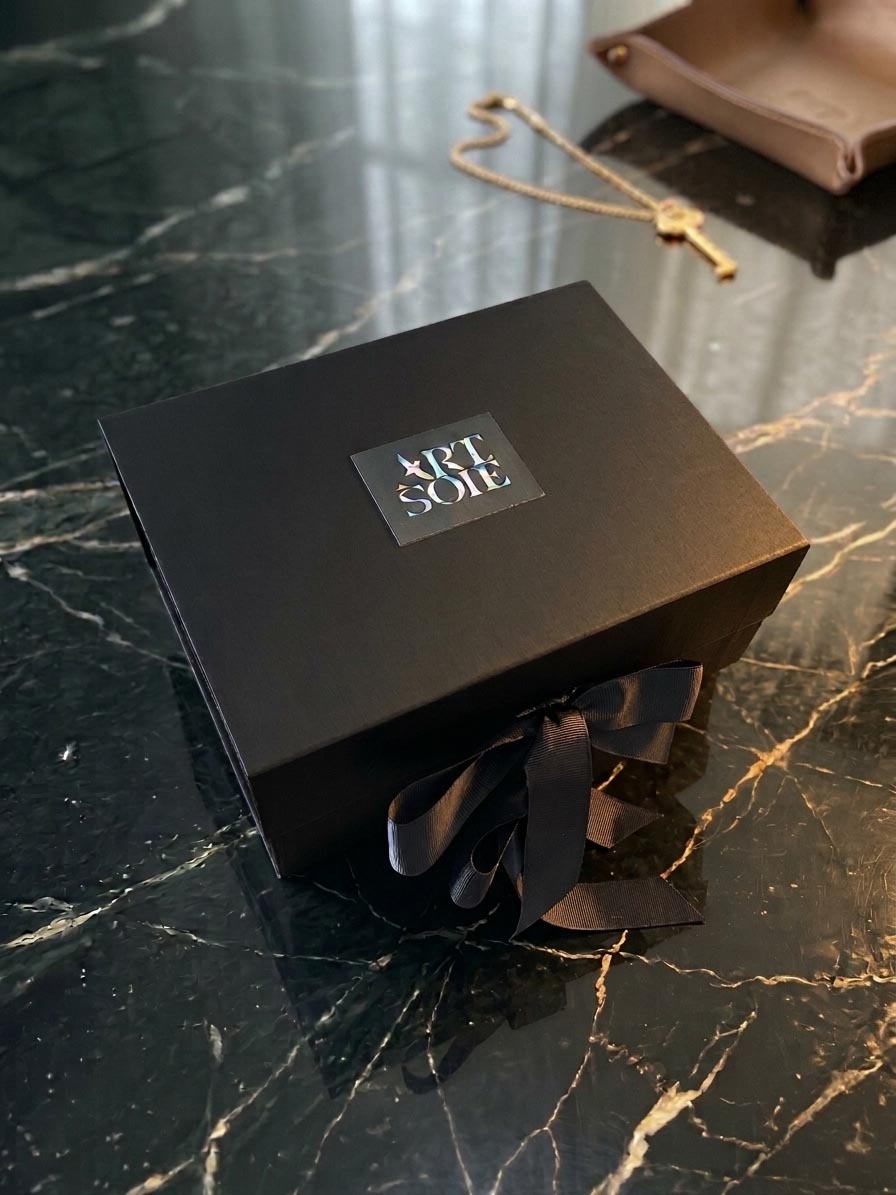
Silk has always known how to survive luxury. Long before luxury became a department, a logo, a seasonal campaign, or an algorithmic category, silk already carried the feeling that something precious had passed through many hands before reaching yours. It required cultivation, patience, skill, and care. It was never just cloth. It was evidence of attention. ArtSoie begins from that older intelligence and brings it into the contemporary art conversation. The premise is simple enough to say: original artworks reimagined on pure mulberry silk. The implications are far richer.
A painting on canvas often asks to be viewed from a respectful distance. A scarf asks to enter the weather of the body. ArtSoie moves between those worlds without apologizing to either. It can be framed as a silk artwork, draped as a scarf, collected as a limited edition, or held as an heirloom. This range is not confusion. It is the work's emotional architecture. It recognizes that the modern collector no longer lives in only one room of identity. The collector may be an art lover, traveler, host, designer, parent, daughter, patron, and person in search of objects that can keep up with a layered life.
The Material Has Memory
Pure mulberry silk has a way of making color feel less printed and more inhabited. Light moves across it with a particular generosity. Blacks deepen, bright colors lift, gradients feel less mechanical, and the hand of the original artwork seems to breathe through the weave. This is why ArtSoie cannot be reduced to merchandise. It is not simply putting an image on a scarf. It is translating one material language into another. Translation is never neutral. It chooses what to preserve, what to release, what to let the new material reveal.
That memory is also tactile. Many collectors are trained not to touch art, and rightly so. Conservation matters. But the desire to touch beauty remains human. ArtSoie gives that desire a lawful place. The silk can be handled with care, folded with attention, worn with intention, and returned to rest. It brings art closer without making it casual. That is a rare achievement. Closeness usually threatens prestige in luxury markets. ArtSoie suggests the opposite: that when material is chosen intelligently, closeness can deepen reverence.
Beyond the Scarf
The word scarf is helpful and inadequate. It names the familiar object, but it does not explain the collectible proposition. A conventional scarf often begins with pattern. ArtSoie begins with artwork. That difference matters. The image comes from an artist's visual language, not from trend forecasting. The silk is not made to complete an outfit for a season. It is made to carry a work across contexts. Around the neck, it becomes personal. In a Veatro frame, it becomes architectural. In its box, it becomes ceremonial. In a collection, it becomes a record of taste.
For scarf lovers, ArtSoie offers a deeper reason to collect. The attraction is not only color, drape, or styling possibility. It is authorship. It is the knowledge that the piece is part of a limited edition, linked to an artist, and born from a gallery ecosystem rather than a fashion calendar. For art collectors, the scarf form softens the usual stiffness of acquisition. It makes collecting less extractive and more intimate. It lets the work live in motion before it returns to stillness.
Sustainable Luxury Without the Lecture
Sustainability can become heavy when it is treated only as proof. Certificates matter, materials matter, and responsible sourcing matters. ArtLoft's own ArtSoie language names pure mulberry silk and OEKO-TEX certification, a textile safety standard associated with testing for harmful substances. Those facts are important because they answer practical concerns about skin, home, and environment. But the deeper achievement is that ArtSoie does not make responsibility feel like deprivation. It allows care to look beautiful.
This is the future of sustainable luxury: not guilt, not austerity, not beige moralism, but objects whose beauty is inseparable from how they are made. A collector should not have to choose between sensual pleasure and conscience. ArtSoie understands that the most persuasive argument for better materials is not always a manifesto. Sometimes it is the feel of silk, the quiet of a box opening, the image catching light, and the realization that responsibility can be refined.
The Heirloom Test
A useful way to judge a collectible is to ask whether it can survive explanation to the next generation. Not whether it will become expensive, because no honest person can promise that, but whether it can carry a story worth retelling. ArtSoie passes this test because it is not dependent on novelty alone. It can be described materially, aesthetically, and emotionally. It began as an artwork. It became silk. It could be worn. It could be framed. It belonged to a movement inside ArtLoft that believed fine art could be sustainable, sensual, and lived with.
Heirlooms are not only things that last physically. They are things that keep their meaning alive. A diamond can fail this test if its story is empty. A letter can pass it if its story is true. ArtSoie sits in a compelling middle ground: materially precious enough to preserve, intimate enough to remember, and visually strong enough to remain present in a room. It is the kind of object that can be inherited not only as possession, but as evidence of how someone once chose to live.
For the Collector Who Refuses Flatness
We live surrounded by images that have no body. They arrive, dazzle, vanish, and are replaced by more images before the first has even settled inside us. ArtSoie slows that cycle. It gives the image weight without making it heavy. It lets a digital age remember fabric, fold, edge, surface, and care. This is not nostalgia. It is correction. The more visual life becomes screen-based, the more meaningful it becomes to own objects that insist on physical intelligence.
Collectors, interior designers, and luxury clients are all searching for this in different languages. Some call it texture. Some call it soul. Some call it provenance. Some call it sustainability. ArtSoie gathers those words into an object that can be seen, touched, worn, and displayed. It understands that the future of collecting may not be about choosing between art and life. It may be about finding forms refined enough to belong to both.
The Ritual of Keeping
A collectible becomes powerful when it changes the way it is kept. Ordinary accessories disappear into storage. Ordinary prints disappear into walls. ArtSoie asks for a different ritual. The silk can rest in its box with the ceremony of an object chosen carefully. It can be unfolded slowly, not because it is fragile in a fearful sense, but because attention is part of its pleasure. It can be worn for a dinner, returned to the wall, or brought out when a room needs a new emotional temperature.
This ritual gives ArtSoie an advantage over objects that depend only on display. A work that can be handled with care creates memory through use. A collector remembers not only where it hangs, but when it was worn, who noticed it, how it felt against the skin, and what it meant to move through the world with an artwork rather than an accessory. That accumulation of lived moments is difficult for static luxury to imitate.
The ritual also matters for inheritance. Future keepers do not receive only silk; they receive instructions embedded in story. This is art you can frame. This is art you can wear. This came from a moment when ArtLoft began insisting that sustainable fine art could be sensual, collectible, and modern. That explanation turns care into culture. It helps the next owner know not only what the object is, but how to respect it.
In that sense, ArtSoie is less a product than a practice of keeping. It teaches owners to slow down, to notice material, to preserve beauty without imprisoning it, and to let art enter the intimate choreography of daily life. That is why it deserves the word heirloom.
This also makes ArtSoie unusually searchable in the deepest sense of that word. People are not only searching for scarves. They are searching for meaningful gifts, sustainable luxury, art for a new home, silk that can be framed, collectible objects for daughters, and rare pieces that do not feel mass-produced. ArtSoie can answer all of these desires because it is not trapped in one commercial category. It is a scarf for one query, an artwork for another, and an heirloom for a third.
The challenge is to keep the language as refined as the object. ArtSoie should never be flattened into novelty SEO. Its value lies in the way it holds multiplicity with grace. The more carefully ArtLoft explains the silk, the artists, the editions, the care, and the option of Veatro framing, the more likely the right collector will understand that this is not a substitute for art or fashion. It is a bridge between them.
That bridge has commercial force precisely because it has emotional truth. A person may arrive searching for a luxury silk scarf and leave understanding limited-edition art. Another may arrive as an art collector and discover the intimacy of silk. A designer may arrive seeking wall texture and discover movement. ArtSoie can welcome all three without losing itself because its center is not trend. Its center is the belief that an artwork can be close to life and still remain worthy of collecting.
The more one thinks about ArtSoie, the more old categories begin to feel insufficient. That is a sign of a strong idea. It does not ask the market to abandon familiar language immediately. It simply gives the language more work to do, until scarf, artwork, heirloom, and collectible begin to overlap.