Collecting | By ArtLoft Editorial |
How Do You Care for and Handle Kinetic Silk?
A preventive-care guide for living with a removable silk artwork and its Veatro display system.
Care starts with the specific edition
There is no universal care instruction for every printed or finished silk. Begin with the ArtLoft documentation supplied for the specific work. Confirm materials, inks, hand-finished areas, Veatro contact points and the approved release method before handling. When condition or compatibility is uncertain, pause and ask the gallery or a qualified textile conservator.
Choose a calm location
Avoid direct sunlight, strong spotlights, moisture, smoke, cooking residue and direct airflow from vents or open windows. Display conditions should be stable enough that the work is not repeatedly striking a wall or nearby object. Light damage is cumulative, so rotation and lower exposure may be more useful than relying on appearance alone.
Handle cleanly and deliberately
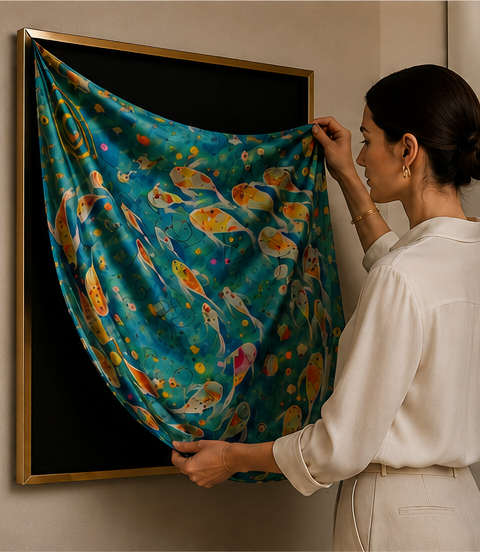
Remove jewelry that can catch, wash and dry hands unless the work's care instructions call for another method, and support the silk rather than pulling from one corner. Prepare a clean, clear surface before release. Do not improvise clips, adhesives, pins or cleaning products.
Return the work using its documented method
Veatro is designed around a specific placement and release sequence. Follow the supplied demonstration and confirm that the silk sits evenly without unexpected pressure. If resistance, distortion or a changed contact point appears, stop rather than forcing the work into position.
Store with a record
If the ArtSoie is removed for a period, use clean archival materials recommended for the object and avoid sharp folds unless the supplied instructions expressly permit them. Label the enclosure with the artwork and edition details. Add dated condition photographs before storage and after reinstallation.
Know when to call a conservator
Seek professional advice for stains, tears, active mold, persistent distortion, uncertain dyes or major condition change. Home cleaning can make a small problem permanent. Good care is rarely dramatic. It is a sequence of modest, documented decisions that reduces avoidable exposure and handling.
Keep a simple display and condition log
Record the installation date, wall, normal light conditions and any planned rotation date. Photograph the front, back, corners and Veatro contact areas in even light. Repeat the same views after release, wear, storage or a move. The value of the log comes from consistency, not elaborate equipment.
The Canadian Conservation Institute notes that light damage is cumulative and irreversible. A record of display duration and conditions is more useful than waiting for fading to become obvious.
Separate routine care from treatment
Routine care includes keeping the room clean, reducing unnecessary light, following the release sequence and checking for visible change. Treatment begins when someone proposes cleaning, stain removal, repair or structural alteration. That work needs a qualified judgment based on the actual materials and condition.
ArtLoft should provide the product and edition instructions it owns. A textile conservator should decide questions that exceed those instructions. The boundary protects the artwork from confident but inappropriate home remedies.
Sources and editorial notes
ArtLoft ArtSoie and Veatro care records, reviewed July 2026
Canadian Conservation Institute: Caring for textiles and costumes Open source
Canadian Conservation Institute: Textiles and the Environment Open source
Reviewed by ArtLoft Editorial. Materially updated 2026-07-13. Read the editorial policy.