Artists | By Rissa Calica | 2026-05-01
Christopher Paris Lacson and the Luxury of Useful Beauty
A reflection on design intelligence, biomimicry, mobility, and art that refuses to separate function from imagination.
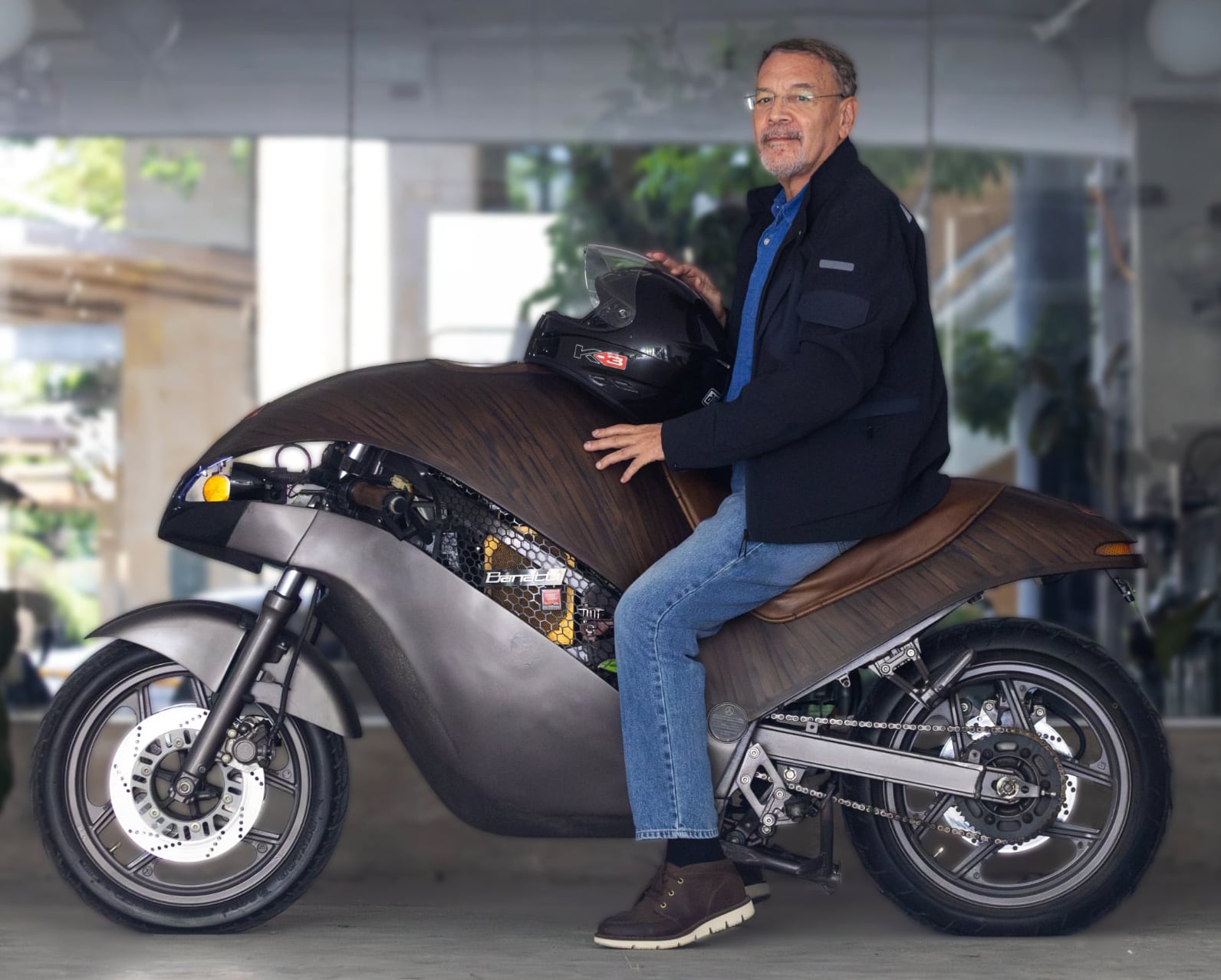
Some creators make objects; Christopher Paris Lacson seems to make arguments in object form. His work moves across architecture, art, transportation, industrial design, furniture, virtual environments, and innovation, yet the movement does not feel scattered. It feels like one long inquiry into useful beauty. What happens when beauty is asked to work? What happens when function is not treated as the enemy of poetry? What happens when sustainability is approached not as a surface message, but as a design problem worthy of intelligence?
ArtLoft's artist page describes Lacson as a design maverick and visionary creator, trained at ArtCenter College of Design, later directing design education in San Francisco, and connected to projects ranging from CAD's early development to biomimetic bamboo-bodied electric motorcycles and co-patented mobility aids. This background matters because it gives his art and design a rare fluency. He is not crossing boundaries for effect. He operates in the place where the boundaries were always artificial.
Function Is Not the Opposite of Art
The fine art world can sometimes treat function with suspicion, as if usefulness lowers the spiritual temperature of an object. Lacson's practice pushes against that bias. A useful object can be conceptually rich. A vehicle can be sculptural. A frame can be philosophical. A mobility aid can contain dignity as a design requirement. A bamboo-bodied motorcycle can carry an environmental argument in its very silhouette. Function does not flatten art when the maker understands function as human context.
This is why Lacson's presence within ArtLoft is important. He expands the gallery's sustainable fine art mission beyond conventional categories. Sustainability is not only pigment choice or reclaimed surface. It is also systems thinking. It is the ability to ask how an object moves through the world, what it consumes, what it enables, and whether its beauty survives use.
Bamboo, Biomimicry, and Material Imagination
The Banatti Green Falcon, associated with Lacson's bamboo-bodied electric motorcycle work, is especially telling. Bamboo is not used here as rustic garnish. It becomes a serious material proposition. Biomimicry and sustainability meet sculptural design and engineering. In a culture that often equates technological progress with synthetic anonymity, bamboo reintroduces growth, grain, and ecological intelligence into the language of speed.
Collectors should pay attention to this way of thinking because it reflects a larger cultural shift. The future of luxury will not be impressed by waste pretending to be power. It will be drawn to objects that make intelligence visible. Lacson's work suggests that refinement does not require disconnection from nature. It may require deeper study of how nature has already solved problems of strength, flexibility, efficiency, and grace.
Veatro and the Design Mind
The Veatro Kinetic Release System sits naturally inside this design philosophy. It is a frame, but not merely a frame. It is a system for holding ArtSoie silk art in tension, allowing movement, and releasing the work when the collector is ready. That is a product idea, a display idea, a mobility idea, and an art idea at once. It requires the mind of someone comfortable with engineering and beauty sharing the same table.
In Veatro, one can see the kind of useful beauty Lacson's broader practice makes legible. The object does something. It does that thing with precision. But the usefulness does not exhaust the object. Instead, the function opens a poetic experience. The silk moves because the frame has been designed to let it. The collector moves because the release system allows it. The room moves because light and air have somewhere to go.
Against Decorative Innovation
Innovation is one of the most overused words in contemporary culture. Too often it means a familiar thing wrapped in new language. Lacson's practice asks for a stricter standard. Innovation should change behavior. It should change how an object is made, used, perceived, repaired, or valued. It should have consequences beyond its press release. This is why his design intelligence feels aligned with ArtLoft's serious collectors. They are not looking for novelty alone. They are looking for work with reasons.
Useful beauty has reasons. It can explain itself through material, form, ergonomics, movement, and human need. It can enter a collector's home without becoming ornamental noise. It can start conversations about sustainability without turning the room into a classroom. It can make sophistication feel practical and practicality feel rare.
The Luxury of Not Wasting Thought
The deepest luxury in Lacson's work may be the refusal to waste thought. Every strong object seems to ask: could this be more intelligent? Could this be more responsible? Could this be more beautiful without becoming less useful? In a market crowded with things made to signal status quickly, that kind of thoughtfulness becomes powerful. It is slow prestige. It rewards the person who notices construction, not only surface.
ArtLoft needs artists and collaborators like Lacson because sustainable fine art cannot remain only a category of images. It must become a way of thinking through objects, systems, rooms, movement, and daily life. Useful beauty is not a compromise. In the right hands, it is the highest form of respect: for the material, for the maker, for the collector, and for the world the object enters.
Design as Cultural Translation
Lacson's importance also lies in his ability to translate between worlds that often misunderstand one another. Artists may distrust utility. Engineers may distrust ambiguity. Designers may be asked to smooth over difficulty rather than reveal intelligence. Lacson's practice suggests that the most interesting objects emerge when these languages are allowed to correct each other. Art gives function a soul. Engineering gives beauty a spine. Sustainability gives invention a conscience.
This translational capacity is vital for ArtLoft because the gallery's most original propositions do not sit neatly inside old categories. Kinetic Silk is art, textile, frame, fashion-adjacent object, and interior presence. Veatro is product, sculpture, display system, and release mechanism. To make such ideas credible, a gallery needs design intelligence that can explain use without draining wonder. Lacson's way of thinking makes that possible.
Collectors increasingly understand this. The old prestige of owning something purely decorative is giving way to the richer prestige of owning something thoughtful. A useful object can reveal the mind of its maker every time it is used. A well-considered mechanism can become part of the artwork's emotional charge. A sustainable material choice can feel less like compromise and more like refinement.
In this sense, useful beauty is not merely a phrase for Lacson's work. It is a forecast for luxury itself. The future collector will want objects that can justify their presence materially, aesthetically, and ethically. Lacson's practice shows that this future does not have to be austere. It can be fast, sculptural, elegant, ingenious, and alive with possibility.
His presence in the ArtLoft ecosystem also helps prevent sustainability from being misunderstood as a return to simplicity alone. Simplicity can be beautiful, but the future also needs complexity handled well. Electric mobility, frame engineering, virtual environments, furniture, architecture, and art all require systems thinking. Lacson's practice insists that responsible design must be allowed to be technically ambitious.
That ambition is attractive to collectors who live with design at a high level. They notice hinges, joins, weight, balance, and the intelligence behind ease. They want art and objects that can stand up to that attention. Lacson's work says that useful beauty is not a lesser beauty. It is beauty tested by life.
This is where his practice becomes valuable for ArtLoft's audience of interior designers, architects, collectors, and luxury clients. He gives them permission to care about how things work without feeling that they have left the realm of art. In fact, his work suggests the opposite: the more deeply an object understands use, the more opportunities it has to become meaningful. Use is not the enemy of imagination. It is one of imagination's most demanding tests.
That test is becoming more important as luxury clients grow more informed. They no longer want beauty that collapses under scrutiny. They want objects whose intelligence increases as one looks closer. Lacson's work is built for that kind of looking.
It is also built for a culture that must redesign its relationship with progress. The old image of progress often meant more extraction, more speed, and more distance from natural systems. Lacson's work proposes a better image: progress as fluency between technology, craft, nature, and human need. That fluency is not sentimental. It is rigorous, and rigor is part of its beauty.