Artists | By Rissa Calica | 2026-05-01
Baron Gimenez and the Animal That Watches Back
A meditation on wildlife portraiture, urban ecosystems, and the collector's encounter with nonhuman presence.
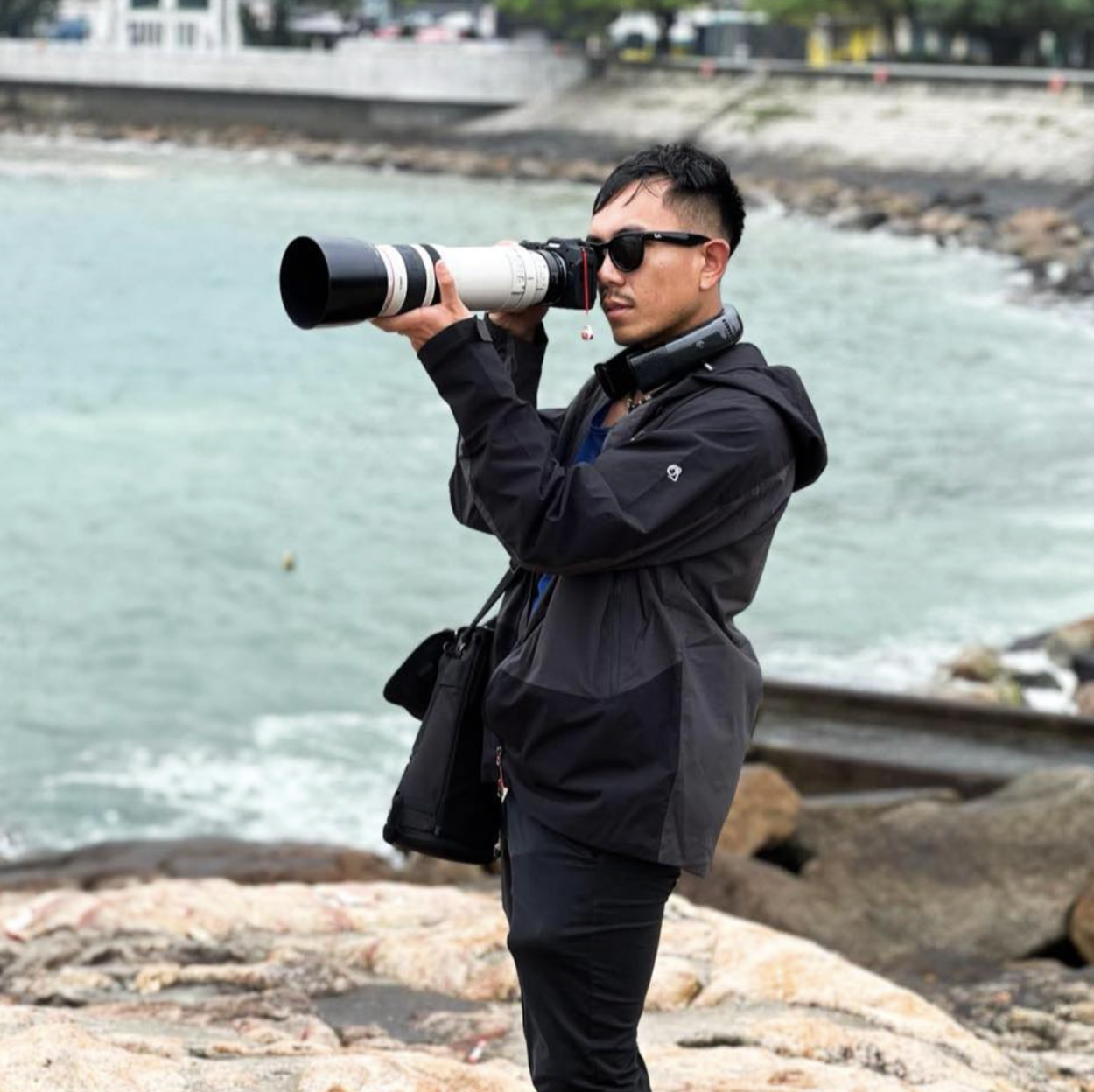
There is a difference between photographing an animal and meeting its gaze. Baron Gimenez works in that difference. ArtLoft describes him as a wildlife portraitist who photographs birds at close range, often close enough to meet their eyes. His work is not about plumage as ornament. It is about presence: intelligence, wariness, focus, and the unsettling moment when wildness seems to acknowledge the observer. In a culture trained to consume animal images as cuteness, spectacle, or symbol, this is a more demanding encounter.
Birds carry ancient associations: freedom, omen, migration, predation, song, fragility, survival. Gimenez does not need to lean heavily on those associations because the gaze itself does the work. A raptor's eye can collapse the viewer's sense of superiority in an instant. It reminds us that looking is not a one-way privilege. The animal is also reading the world. The camera does not simply capture. It enters a field of awareness.
The City Is Not Empty of Wildness
Gimenez shoots across unlikely terrain, including the Pasig River's recovering ecosystem, Batangas coastlines, La Union wetlands, and places beyond the Philippines such as Hong Kong, Taipei, Bali, and Egypt. This range matters because it resists the fantasy that nature exists only elsewhere. Wildness is not confined to pristine distance. It persists in edges, waterways, shorelines, rooftops, and contested habitats. The bird becomes a witness to overlap.
For ArtLoft's sustainable fine art mission, this is essential. Sustainability cannot remain an abstract love of nature. It must pay attention to actual habitats, including those compromised by human presence. Gimenez's work asks collectors to see birds not as decorative wildlife, but as residents of shared environments. The photograph becomes a form of attention paid to coexistence.
Apex Focus
The phrase apex focus captures the charge of Gimenez's portraits. A bird of prey locking eyes with the lens is not performing for human admiration. It is assessing. The image holds a precise concentration that many human portraits never achieve. This gives the work unusual power in a room. It does not merely add nature. It adds another consciousness. The collector is not looking at scenery. The collector is being looked at.
That reciprocal gaze changes the emotional temperature of an interior. In a living room, it introduces alertness. In a study, it sharpens thought. In a hallway, it creates a threshold. Art does not have to be abstract to be profound. Sometimes profundity arrives through the undeniable fact of another being's attention.
Printed on Wood, Returned to Matter
ArtLoft notes that Gimenez's images are printed on sustainably sourced wood, embedding the photograph into natural material rather than over it. This choice is more than presentation. Photography can sometimes feel disembodied, especially when viewed through screens. Wood gives the image density, grain, and a material relationship to the living world it depicts. The bird is not floating in digital nowhere. It returns, in a sense, to matter.
This creates a subtle ethical alignment. The subject is wildlife. The support is natural material. The collector is invited to consider not only the image, but the surface that carries it. It is another example of ArtLoft's belief that how art is made matters. The photograph's message does not end at representation. It continues through the object.
For Collectors Who Want Presence, Not Decoration
Wildlife art can easily become decorative when it prioritizes beauty without encounter. Gimenez's work avoids that by focusing on presence. The bird is beautiful, but beauty is not the endpoint. The endpoint is recognition: the awareness that the nonhuman world is not background. It watches, responds, adapts, survives, and sometimes stares straight through our illusions of control.
Collectors drawn to this work are often people who want nature in their homes without reducing it to softness. They want strength, alertness, and the discipline of the wild. Interior designers may use such work to bring organic intelligence into a refined space. Art collectors may value the way the image holds both documentary immediacy and symbolic depth.
The Animal That Watches Back
The title of this essay is the simplest truth of Gimenez's practice. His subject watches back. That return of gaze is a gift and a warning. It reminds us that the natural world is not passive content for human consumption. It is alive with its own purposes. When brought into a collection, the image can become a daily correction to human-centered design.
This is why Baron Gimenez belongs in ArtLoft's ecosystem. His work broadens sustainable fine art beyond material choice into ecological perception. He teaches the collector to look at the wild not as escape, but as intelligence. The photograph becomes a meeting, and the room that holds it becomes less alone.
The Collector as Witness
To collect wildlife portraiture responsibly is to become a witness, not merely an admirer. The difference is important. Admiration can remain passive. Witnessing implies obligation, attention, and memory. Gimenez's birds ask for this deeper role because they are not staged symbols of nature. They are beings encountered in actual environments, often where human and wild territories overlap. Their presence in a collection keeps that overlap visible.
This witnessing can change how a room feels. A bird portrait printed on wood does not only bring organic texture or a beautiful subject into an interior. It brings another intelligence into the field of daily life. It makes the collector aware that the world outside the room is not scenery. It is inhabited. It is alert. It may be recovering, threatened, adapting, or watching.
For designers, this can be a powerful counterweight to interiors that risk becoming too self-contained. The bird's gaze punctures the sealed luxury bubble. It introduces wild attention without visual chaos. It gives a refined space an ethical window. That window does not preach, but it does not let the room become complacent either.
In ArtLoft's broader philosophy, Gimenez's work proves that sustainability is also a way of seeing. Materials matter, but perception matters too. A collector who learns to see the nonhuman world as presence rather than decoration is already practicing a more responsible form of beauty. Gimenez gives that practice an image.
His photographs are also useful for a search landscape that often treats wildlife art too broadly. A person may search for bird photography, raptor art, nature wall art, sustainable wood prints, or art for biophilic interiors. Gimenez belongs in all of those conversations, but his work should not be reduced to any single one. The decisive feature is not the bird alone. It is the encounter between gaze, habitat, material support, and collector awareness.
That encounter gives the work staying power. Many nature images soothe. Gimenez's best images do something more complicated. They soothe and unsettle at once. They offer beauty, but they also return attention. A collector living with such a work may find that it changes not only the room, but the way the window, the sky, and the nearby trees are seen afterward.
This aftereffect is one of the strongest signs that an artwork has entered consciousness rather than merely decor. The room may remain the same, but the viewer is altered. Gimenez's birds train the eye toward alertness. They remind collectors that sustainable living is not only a matter of buying better objects. It is also a matter of noticing the lives that continue beyond human design.
That noticing may begin with a photograph, but it should not end there. A collector who lives with Gimenez's work may become more attentive to rivers, wetlands, coastlines, and city birds. The artwork becomes a door back into the actual world.
This matters because ecological concern often fails when it remains too abstract. People protect what they can imagine, and they imagine more deeply when an encounter has become personal. Gimenez makes the encounter personal through the gaze. The bird is not a statistic, not a symbol pasted onto a cause, but a presence with its own alertness. That presence can make care feel less like duty and more like recognition.
For ArtLoft, this kind of recognition is part of the gallery's broader work. Sustainable fine art is not only about better materials. It is about better relationships: with artists, objects, habitats, homes, and the forms of life that exist beyond human convenience. Gimenez's photographs make that relationship visible in a single stare.
That stare also gives collectors a language for strength that is not aggressive. A bird's vigilance is precise, economical, and necessary. It carries power without excess. In a refined interior, that kind of image can become a daily reminder that elegance and survival are not opposites. Sometimes the most graceful thing in the room is also the most alert.
For anyone who believes art should heighten perception, that is enough reason to keep looking. It is also enough reason to collect slowly, with respect for the living world and the rooms where attention is renewed through beauty, patience, care, and quiet daily devotion too.